
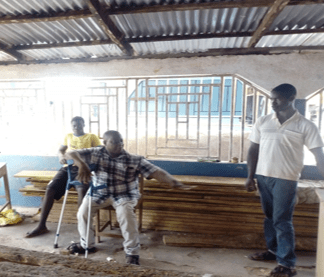
Funding from ElectricAid has helped improve the livelihoods and quality of life of women and men with disabilities living and working in the Village of Hope in Kambia District, Northern Sierra Leone. 100 women and men now have access to improved latrine and water facilities and 75 of those women and men now have quality tools, equipment, workspaces and materials to develop marketable products and increase their income.


Four workshops were fully equipped with appropriate tools, equipment and machines with which they are now able to produce quality products and serve their customers in a timely manner, thus, generating more money to take care of themselves and their households. The now fully equipped metal, tailoring, carpentry and rubber tip-making workshops have given 75 women and men a competitive advantage over their counterparts as they have enhanced the quality of production. Two key products of these workshops are affordable and durable crutches and wheelchairs. As a result of the improvements to the workshops, users of crutches and wheel chairs now have improved access to locally fabricated crutches and wheelchairs at more affordable prices.
An exhibition centre was constructed with three rooms, one for each department of welding, carpentry, and tailoring, and a room was created for the new rubber-tip production workshop. Before the construction of the exhibition centre, every morning the women and men with disabilities working there had to move all finished products outside for exhibition and to make free space for work, and in the evening bring the items back inside. This was very challenging and time wasting. With the construction of the exhibition centre this will no longer be necessary.


100 women and men with disabilities, living and working in the Village of Hope, now have access to disabled friendly toilets and washing facilities. Four toilet and bathing rooms with running water, two for male and two for female, were constructed, with two rooms for wheelchair users and two for crutch users. A ramp was constructed at the main entrance, and the doors and rooms are wide enough to allow wheelchair users to enter and close the door behind them.
This project goes a long way towards supporting the UN’s Sustainable Development Goals. Access to clean water and sanitation (Goal 6) is improved as well as improved equality for people with disabilities (Goal 10). This benefits health and well-being (Goal 3) while promoting infrastructure and industry (Goal 9)


 electricaid.ie