

S. Lielbarde – CBM Ireland
CBM Ireland is an Irish charity working alongside people with disabilities in the world’s poorest places to fight poverty and exclusion and transform lives.
In 2018, CBM initiated the Bridge the Gap programme in the Amhara Region of Ethiopia. The Bridge the Gap team works with government officials, hospitals, and schools to build communities that welcome and care for everyone equally. CBM believe that if people with disabilities have their voices heard, they can help shape their communities for the better.
Over the last two years, Electric Aid has generously supported Bridge the Gap, providing a total of €83,058.
Amhara is one of the most populated and most impoverished regions in Ethiopia, with a disability prevalence higher than the countrywide average of 15.6%.
People with disabilities are highly vulnerable in Amhara. Stigma is pervasive. People with disabilities are seen by many as helpless, in need of constant care, and as economic burdens to their families. This stigma, in turn, makes accessing essential services and care extremely difficult.
Girls and women with disabilities are even more vulnerable and at greater risk of violence.
The stigma and discrimination that people with disabilities face from all corners of society in Amhara has led to a mental health challenges: large swaths of the disabled community report experiencing massive levels of mental distress.
But thanks to Electric Aid’s support, some positive changes for people with disabilities can be observed now in the areas of health, education, and livelihood. –
Two assistive device workshops have now been established in the Amhara Region, allowing wheelchairs, crutches and other assistive devices to be produced. People with disabilities are being given their independence once more and a chance to engage in community life.
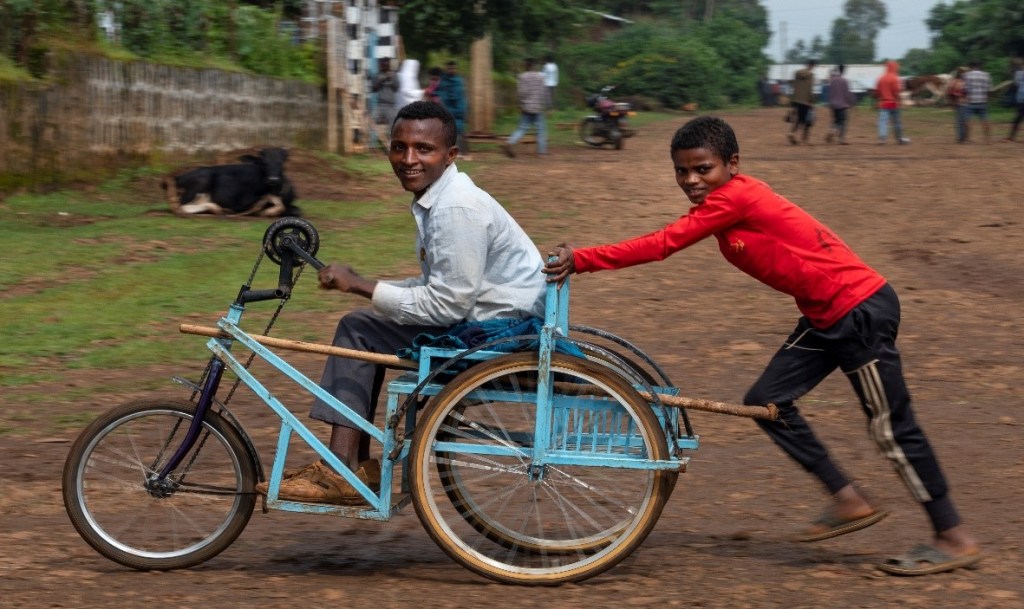
Anbessamie, Ethiopia – 2019-09-06 – Destaw Derso, who has a mobility impairment, gets a push start from Mekuanint Tadesse, 11, in Anbessamie, Ethiopia, on September 6, 2019. Tricycles, and other assistive devices, are built at the workshop of CBM-partner Cheshire Foundation Action on Inclusion in nearby Bahir Dar by Alemayhu “Alex” Teka, who had polio as a child.
To address the undernourishment of children with disabilities from poor families, at least 120 households have been supported with nutritious food supplements for a period of one year. CBM’s ready-to-go nutritional support addresses this need in the short term, while investments in health and education will bridge the gap in the long run.
Four health centres and eight schools were recently renovated and made disability-friendly: Schools were equipped with accessible learning materials and sign language dictionaries so that every child is given the best possible opportunity to learn.
The COVID-19 pandemic has been felt acutely by people with disabilities. People with disabilities are often excluded from support during an emergency and are more likely to miss Covid-19 messaging and medical care. Electric Aid has provided personal protective equipment to 1,710 families so that CBM’s project team can continue their work and so that vulnerable groups can keep themselves safe.
Crises like the Covid-19 pandemic disrupt society and as a result of that disruption, hard won progress risks coming undone. With Electric Aid’s help, CBM is working to ensure that does not happen.

Debre Tabor, Ethiopia – 2019-09-04 – Worky Belay uses her tricycle in Debre Tabor, Ethiopia, on September 4, 2019. Worky lost mobility in her right leg 20 years ago in a farming accident; recently, she received a tricycle through Bridge the Gap, which she is still learning how to use.
 electricaid.ie